Emile Zhukovsky
A Gentleman in MoscowEmile Zhukovsky is the chef whose fierce standards keep the Boyarsky Restaurant in motion, but his role extends beyond the kitchen: he is a daily partner in the Metropol’s informal leadership and a friend whose gruffness cannot conceal his affection. The novel sets his pessimism against the precision and pleasures of his craft, then shows how the friendships built around that work endure when the Count disappears.
Identity and Daily Work
At two o’clock, the Boyarsky Restaurant kitchen is already running at full pace. Junior chefs chop carrots and onions; Stanislav, the lanky Estonian sous-chef, debones pigeons; eight burners simmer sauces, soups, and stews; and the flour-dusted pastry chef pulls trays of brioches from the oven. Emile stands at the center of this activity, watching his assistants and moving among the pots with a chopping knife in hand. The kitchen resembles an orchestra, and Emile its conductor.
The knife is a ten-inch chopper, two inches wide at its base, that Emile keeps close even though the kitchen has specialized paring, boning, carving, and cleaver knives. He uses it to skin a rabbit, zest a lemon, peel and quarter a grape, flip a pancake, stir soup, or measure a pinch of seasoning. Its most characteristic use, however, is pointing. He wields it to rebuke a saucier for reducing a sauce too far and to scold an apprentice whose parsley is taking too long to mince. The instrument is at once a practical extension of his skill and a vivid emblem of his authority.
That authority can be theatrical. While Stanislav trims lamb, Emile abruptly points the chopper at his nose and demands to know what he is doing. Before he can continue, Andrey arrives carrying the restaurant’s Book. Emile slips the chopper beneath his apron tie, as if caught in the middle of a skirmish. The comic change in posture does not make the threat unreal: he then brings the blade down hard enough to split a lamb chop from its rack. The kitchen’s high standards are enforced through work, attention, and intimidation in equal measure.
Temperament and Craft
Emile begins each day in the blackest pessimism. He meets existence with a scowl, finds confirmation of his suspicions in the morning papers, and mutters about the state of the world while waiting for a crowded tram to take him to the hotel. Yet the kitchen gradually changes the terms of his day. At noon, the sight of copper pots still shining after the previous night’s cleaning begins to suggest that all may not be lost. Lifting a side of lamb onto the counter improves his outlook further; the sound of chopped vegetables and the smell of garlic bring him, by mid-afternoon, to concede that existence has its consolations.
This daily reversal makes his pessimism more than a fixed pose. It is repeatedly tested by the tangible order of the kitchen: clean equipment, good ingredients, and assistants ready to work. At 5:55, shortly before the restaurant opens, the Count sees those assistants waiting in freshly bleached coats, sauces simmering and garnishes ready. Emile’s disposition and the kitchen’s disciplined preparation pull in opposite directions, but the work repeatedly converts bleakness into a guarded confidence that the evening can be done well.
The Daily Council and Its Colleagues
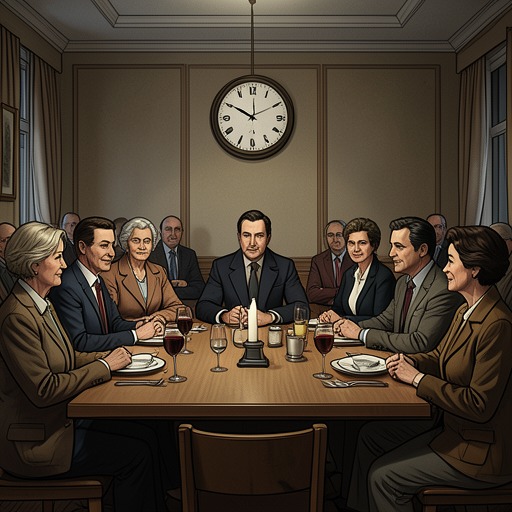
At 2:15 each day, Emile meets with Andrey and Count Alexander Ilyich Rostov in a small office overlooking the kitchen. This Triumvirate decides the fate of the restaurant’s staff, customers, chickens, and tomatoes. Andrey opens the Book and reports the reservations; the three colleagues consider the evening’s practical demands. Their authority is informal but consequential, grounded in the daily decisions needed to make the restaurant function.
Emile’s manner at these meetings remains characteristically brusque. When Stanislav brings cucumber soup and rack of lamb with red-wine reduction, Emile dismisses the sous-chef’s announcement as something they already know. Once Stanislav has left, however, he presents the dishes to his colleagues and ladles soup into two of the three teacups for them to taste. Andrey calls it excellent. Emile’s impatience with ceremony does not prevent him from seeking his colleagues’ judgment; the tasting is one of the small routines through which the three men share responsibility.
The Count’s arrival at one such meeting follows a brief episode of workplace comedy: after Andrey enters, the swinging door opens again and the Count appears with a white Boyarsky dinner jacket over his arm. The meeting that follows is both practical and intimate. Once the staff are absorbed in their work, the Count produces an envelope that has been slipped under his door. Red and golden filaments spill onto Emile’s unused teacup. The three men fall silent. The moment interrupts the ordinary business of the council, but the evidence leaves the contents unexplained; what matters here is the sudden, shared gravity with which they receive it.
Affection Beneath the Bluster
Emile’s connection to Sofia appears most clearly through food. When the Count invites the Triumvirate into his hidden study, Emile encounters Anna Urbanova there and is struck speechless: unbeknownst to the others, he has seen every one of her films, usually from the second row. He starts to offer her the cake he is carrying, but when she asks whether it is meant for Sofia, he turns to the girl instead. He has made Sofia’s favorite, a Dobos torte with chocolate cream, shaped like a piano. Sofia thanks him as her uncle. His embarrassment and the care invested in the cake reveal a tenderness that his kitchen manner usually keeps under cover.
That care also travels through the hotel’s comic traditions. Emile creates Goose à la Sofia, a dish whose preparation is described as hoisting a goose in a dumbwaiter, chasing it down a hall, and throwing it from a window before roasting it. The extravagant method turns the hotel’s mishaps into a culinary joke. When Andrey serves it to the Count and Sofia, the meal opens into family stories about commotion on the fourth floor and Anna Urbanova throwing her clothes out a window before collecting them in the night. Emile is not present in that telling, but his dish helps make the restaurant’s shared history part of the family lore the diners exchange.
Change, Farewell, and Narrative Role
The hotel’s administration changes the conditions of Emile’s work. The Bishop, Manager Leplevsky, ends the custom of tasting the evening’s specials, reasoning that the chef already knows his own food and that samples for staff are wasteful. Instead, Emile must write out a description by hand. During one meeting, the Bishop marks up the menu and suggests beets with pork rather than apples, noting that a bushel of beets remains in the pantry. When the meeting ends, Emile leaves grumbling in search of them. His craft remains central, but the decisions governing it are increasingly subject to managerial interference.
A more personal disruption comes when Andrey reports a worsening tremor in his right hand, a symptom he fears is the onset of palsy. Emile watches in shock. His response registers the cruelty of a malady that threatens the very attribute by which Andrey has distinguished himself. When Andrey is subsequently able to take part in the Count’s farewell, Emile joins the hotel staff gathered around Sofia as she leaves for Paris. He stands there in his apron beside Andrey, Arkady, Vasily, and Audrius, part of a circle that sees Sofia off with affection and a touch of generational envy.
After the Count and Manager Leplevsky have disappeared, Emile and Andrey hold their 2:15 meeting and spend far more time considering the Count’s absence than the manager’s. They take comfort from the KGB’s frustration, which suggests that the Count has not been caught, while rumors circulate that Sofia has vanished in Paris. A mail clerk brings them two unusually weighty envelopes. The letters thank each man for his fellowship, promise that the Night of the Bouillabaisse will not be forgotten, and enclose four gold coins apiece. The familiar, formal handwriting confirms that the Count is at large and has remembered his friends.
Emile’s relief turns quickly to grief and uncertainty. With the Count gone and Andrey supposedly afflicted with palsy, he wonders what will become of him. Andrey answers that his hands are as agile as ever, correcting the premise on which Emile’s fear rests. The exchange leaves Emile not with a solved future but with the companionship that has sustained his daily work: the chef’s gruff question, the maître d’s reassuring answer, and the absent Count’s tangible token of friendship. Through Emile, the restaurant’s exacting routine becomes a form of fellowship, and the hotel’s chosen family persists even when its members are scattered.